 Beefy finance
 vault withdrawal tokens and conversion choices
Beefy finance normally returns a vault’s underlying asset when you redeem your vault shares. For a standard liquidity pool vault, that asset is the LP token. Receiving a different token requires an available Zap route or a separate conversion after withdrawal. Your original payment token does not determine the exit asset if you used a Zap to enter. Before signing, distinguish the asset that the vault returns from the token that a conversion would deliver.
- updated
Key takeaway: A direct withdrawal preserves the vault asset, while receiving a different token requires a supported conversion route.
Choose between the vault asset and a converted output
A direct redemption fits an exit into the vault asset; a Zap fits an exit requiring supported conversion. A successful deposit through a Zap does not reserve the reverse route. Withdrawal options depend on the selected vault, available liquidity, and supported output tokens.
A single-asset vault ordinarily returns its designated asset through direct redemption. An LP vault ordinarily returns a token representing liquidity in its underlying pool. The Zap can add liquidity removal and swaps where the route supports those operations. Its output selection therefore describes a transaction beyond the vault withdrawal itself. Review the proposed output rather than assuming that every token available elsewhere in the application is available for this exit.
Match the withdrawal claim to the asset before requesting a quote
The vault position and its redeemable asset establish what you can withdraw before any conversion enters the calculation. For standard vaults, mooTokens represent the withdrawal claim. Their quantity need not equal the amount of the underlying asset they represent. A withdrawal amount expressed in LP tokens therefore needs a different interpretation from an amount expressed in vault shares.
Check the connected account, the vault’s network, and the asset identified by the withdrawal option. For tokens, match the contract identity as well as the displayed symbol. Keep enough native network currency for the transactions you must submit. Where a Zap requests spending permission, that permission must cover the relevant input. An approval alone does not redeem the position or establish the final output.
Does a direct LP vault withdrawal return the separate pool tokens?
A direct withdrawal from a standard LP vault returns LP tokens, leaving liquidity removal as a separate operation. The standard Beefy vault withdrawal burns mooTokens and transfers the corresponding underlying vault asset. When that asset is an LP token, the pool position remains intact after redemption. Separating its constituent assets requires the pool’s liquidity-removal mechanism or a supported Zap.
Beefy Cowcentrated Liquidity Manager (CLM) products have a different redemption structure. Their direct withdrawal returns a proportional share of the tokens that the product holds. The quantities reflect the position at withdrawal, rather than restoring the original deposit quantities. Distinguish redeeming a standard vault from redeeming the underlying CLM position when the product includes both layers.
Conversion changes the output amount and its cost
A Zap quote estimates the chosen token output after the proposed conversion, while market conditions can change before execution. Slippage describes movement between the quote and execution. Price impact describes the effect that the trade itself has on the market price. Slippage protection does not remove the price impact of a Zap’s swaps. A route through limited liquidity can therefore offer an unattractive quote even before any subsequent price movement.
Review the expected output, any minimum-output condition, and the costs that the preview includes. Where the transaction enforces a minimum, lowering it accepts a worse possible execution. That adjustment does not improve liquidity. Vault withdrawal charges, conversion charges, and network gas have different causes; the exact combination depends on the selected exit. Compare the amount you would receive with the asset you would hold after direct redemption, keeping their different units clear.
Signing commits the withdrawal instructions
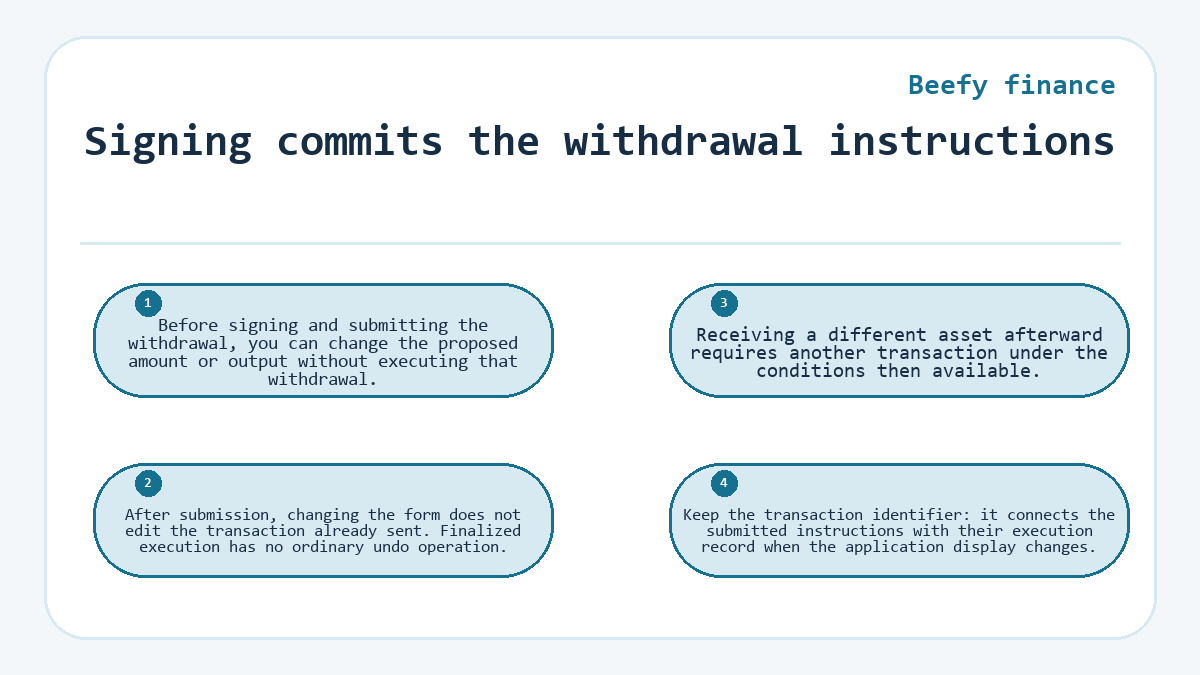
Before signing and submitting the withdrawal, you can change the proposed amount or output without executing that withdrawal. After submission, changing the form does not edit the transaction already sent. Finalized execution has no ordinary undo operation. Receiving a different asset afterward requires another transaction under the conditions then available. Keep the transaction identifier: it connects the submitted instructions with their execution record when the application display changes.
A direct LP withdrawal before deciding on conversion
Consider a hypothetical exit in which the account holds shares in a standard LP vault and the intended output is a constituent pool token. Assume direct redemption is available, but no acceptable Zap quote exists. The account holder wants to confirm each asset received before authorizing another operation.
The direct withdrawal preview identifies the LP token as its output. That matches an intermediate asset the account holder is willing to retain. Before signing, the proposed withdrawal remains changeable. Choosing this path leaves the separate liquidity-removal decision open.
The account holder submits only the direct redemption. In this hypothetical outcome, the withdrawal succeeds. Its record shows the redeemed vault shares leaving circulation and the LP tokens arriving in the account.
The account holder reconciles those transfers with the remaining vault shares and the new LP balance. The balance matches the LP token identified before submission. The intended constituent token has not arrived, because this transaction did not remove liquidity or execute a swap.
The completed result is an LP position held directly in the wallet. The account holder stops there until the pool’s redemption output is acceptable. Keeping the LP token preserves exposure to that pool; it postpones conversion without reversing the completed vault withdrawal.
Underlying liquidity can restrict an otherwise valid exit
A supported output token does not establish that the underlying strategy can release funds immediately. Some lending strategies must unwind borrowing before accommodating withdrawals. Insufficient lending-market liquidity can prevent that unwind. Changing the Zap output cannot bypass this dependency. Conversely, a conversion-route failure does not by itself prove that direct redemption is unavailable. Identify whether the obstacle affects release of the vault asset or its subsequent conversion.
Choose the next operation from the asset actually received
After redemption, the received asset determines the remaining exit options. Holding LP tokens leaves the pool position in place. Removing liquidity changes that position into the assets that the pool returns. Swapping afterward changes the token exposure again. Separate operations give you a balance to inspect between commitments, while adding transactions and leaving market exposure between them.
A route across networks introduces another completion boundary. Where supported, Beefy’s crosschain Zap infrastructure coordinates source-chain activity with execution on the destination chain. Source-chain success alone does not establish that the requested destination output arrived. Destination execution can also enter a refund or recovery path. Match the received asset, network, and recipient to the recorded outcome before committing those funds to another operation.
Beefy finance: common questions
Can I withdraw part of my vault position?
Standard Beefy vault contracts support redeeming a specified quantity of vault shares. The remaining shares retain their claim on the vault. Check the unit used by the withdrawal form, because the displayed underlying-asset amount can differ from the number of shares redeemed.
Will a withdrawal pay accumulated farming rewards as separate tokens?
An ordinary autocompounding vault withdrawal returns the vault asset rather than a separate allocation of every farming reward token. The strategy harvests and reinvests rewards into that asset. Pending rewards may not yet appear in the redeemable balance, depending on the strategy’s harvesting behavior.
Is a retired vault label proof that withdrawal is impossible?
A retired label alone does not establish that redemption is impossible. Withdrawal availability depends on the vault contract, its strategy, and access to the underlying assets. Retiring a strategy and losing access to its funds are different conditions.
Does an emergency strategy withdrawal send assets straight to my wallet?
A strategy panic operation normally moves funds from the external farm back to the strategy contract. It does not itself redeem each user’s vault shares into their wallet. Its purpose includes making recovered assets available for user withdrawals, subject to the strategy’s actual recovery and withdrawal conditions.
What happens to my completed withdrawal if I deposit the received tokens again?
A new deposit creates another vault entry; it does not reverse the earlier withdrawal. The old transaction remains in the history, and the new deposit uses the share value and conditions at its execution. Any earlier conversion costs and network fees remain part of the completed exit.